Every luxury buyer has seen the word Pashmina printed on a label. But walk into any wholesale market in Europe or North America and you’ll find scarves marketed as “Pashmina” that contain zero Pashmina fibre at all.
For brands that care about what they’re selling — and more importantly, what they’re promising their customers — understanding what authentic Pashmina actually is, where it comes from, and how to verify it has become a genuine competitive advantage.
The Origin of the Fibre
Pashmina comes from the undercoat of the Changthangi goat (Capra hircus), native to the high-altitude Changthang plateau in the Himalayas — regions spanning Ladakh, Tibet, and parts of Nepal above 4,000 metres. The extreme cold forces these goats to grow an exceptionally fine undercoat, typically between 12 and 16 microns in diameter.
To put that in context: regular wool averages 18–25 microns. Cashmere — already considered a luxury fibre — sits at 15–19 microns. Authentic Pashmina is finer than both.
The altitude isn’t just geography — it’s the quality standard. No other region in the world produces a fibre this fine under natural conditions.
The fibre is collected by combing, not shearing — a labour-intensive process done by hand each spring during the natural moulting season.
Why Nepal Is the Processing Hub
Raw Pashmina fibre from high-altitude regions has historically flowed into Kathmandu for processing — and for good reason. Nepal’s artisan communities have refined Pashmina spinning, weaving, and finishing techniques over centuries. The knowledge is generational, and the craft infrastructure (hand looms, traditional dyeing, hand embroidery) exists here at a density that nowhere else can match.
At Rita Industries, every piece begins with raw fibre and ends with a finished, labelled product ready for your retail floor. The entire process — spinning, weaving, dyeing, quality inspection, packaging — happens under one roof in Kathmandu.
What that means for your brand:
1) Full traceability from fibre to finished product
2) No third-party intermediaries inflating cost
3) Consistent quality because you’re not stitching together multiple suppliers
4) Private label and custom branding included
How to Tell Real Pashmina from Imitations
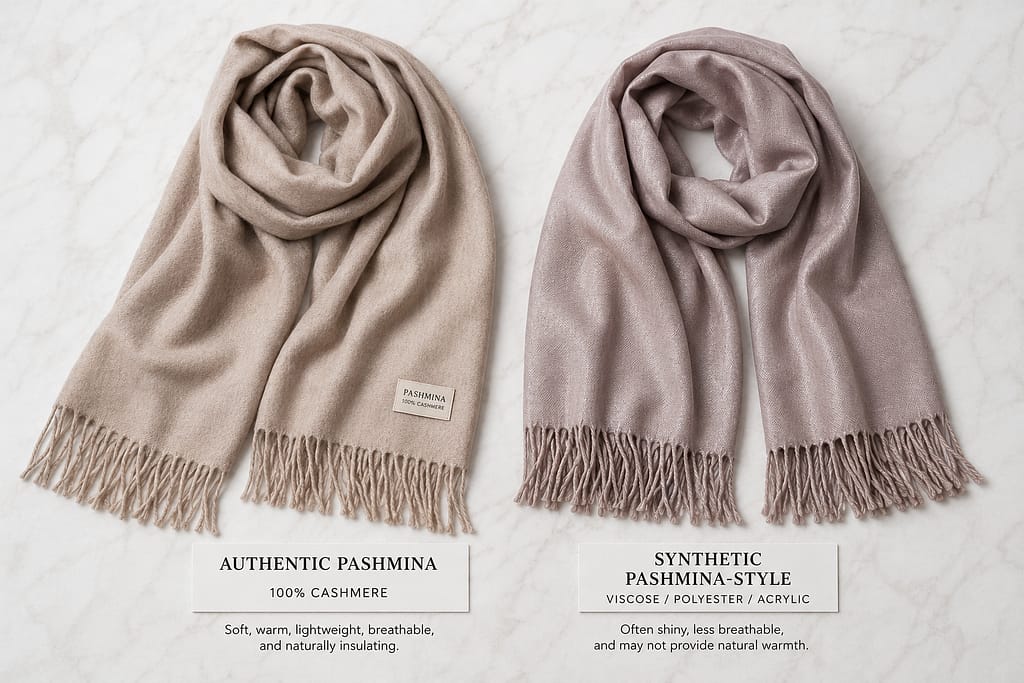
There is no visual shortcut to verifying Pashmina quality. The most reliable method remains fibre diameter testing — conducted in a laboratory using microscopy. This is the standard Rita Industries uses for every production batch.
But there are practical indicators buyers can assess before a lab test:
| Indicator | Authentic Pashmina | Synthetic / Mixed |
|---|---|---|
| Warmth-to-weight | Extremely warm, barely any weight | Heavy and still not as warm |
| Softness | Immediately soft, no break-in | Often rough or slightly scratchy |
| Ring test | Passes through a finger ring | Too thick to pass |
| Pilling | Slight initial pilling, then stops | Heavy pilling that worsens over time |
| Burn test | Burns like hair, self-extinguishes | Melts, smells synthetic |
| Note for buyers: Always request fibre composition certificates and ideally lab test reports for any new supplier. Any reputable manufacturer will supply these without hesitation. |
What the Market Rewards
The global Pashmina and luxury shawl market is projected to exceed USD 4.8 billion by 2030, driven by growing consumer preference for:
1) Verified natural fibres over synthetic alternatives
2) Ethical and transparent supply chains
3) Heritage craft and cultural story in a product
The brands growing fastest in this space are not necessarily the ones with the biggest marketing budgets — they’re the ones able to tell a credible, specific story about where their product comes from and who made it.
Authentic Himalayan Pashmina, sourced from a traceable Kathmandu manufacturer, gives you exactly that story.
Working With a White-Label Manufacturer
If you’re a brand considering adding a Pashmina line — or scaling an existing one — white-label manufacturing removes the two biggest barriers: production expertise and minimum order economics.
At Rita Industries, we work with brands at every scale, from boutique labels placing 50-piece orders to established retailers with 5,000-piece seasonal runs. The product is yours — your label, your packaging, your colours — backed by our manufacturing infrastructure and quality standards.
To start, all you need is:
1) Your target price point
2) Preferred dimensions and weight
3) Any colour or design references
4) Your branding assets
We handle the rest.
| Ready to add authentic Pashmina to your collection? Request a sample — no commitment, just the product in your hands. |